Scientific Library of Institute of Botany, Tbilisi, Georgia: Algae in the Planted Aquarium: Algae in the Planted Aquarium Assembled by Kris Weinhold Table of Contents Introduction Black Brush/Beard (Rhodophyta) Brown Algae...
Thursday, September 26, 2013
Scientific Library of Institute of Botany, Tbilisi, Georgia: Diatoms
For much of the course of life on Earth, these microscopic algae have been, and are still, extremely important. More than 10,000 living diatom species are known, with about the same number of named fossil forms.
Over ninety percent of the biosphere is plant life, of which diatoms make up about a quarter by weight. They are enormously abundant in the upper layers of the world's oceans, providing high-grade nutrition to creatures as diverse as protozoans and baleen whales, and supplying the atmosphere with around a quarter of its oxygen.
Most diatoms are much less than half a millimetre in size, but their oil-rich, silica-shelled bodies, sinking to the ocean floor in vast numbers over long periods of time, have been transformed into the petroleum deposits of the world, and their skeletons have formed thick strata of diatomaceous earth which has found application in human products as varied as dynamite and (in earlier times) toothpaste.
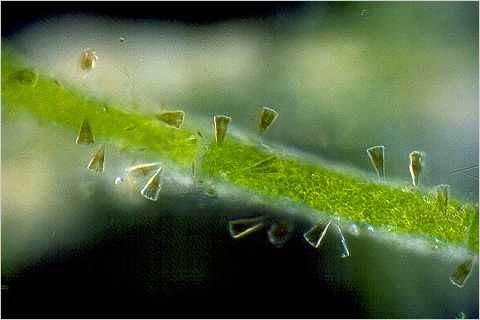
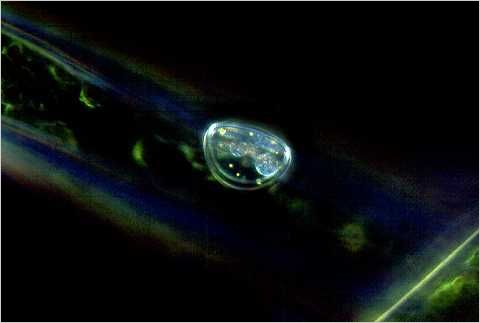
Whilst most diatoms are to be found in the oceans, they are also abundant and important in freshwater habitats and in moist soil. The siliceous skeleton common to all varieties is frequently described as structured like a pill box or Petri dish, and offers two possible views -- the valve view (as in viewing a Petri dish from the top) and the side or girdle view. They present a great variety of shapes (mostly symmetrical) in valve view, but most commonly are rectangular in girdle view (See Cocconeis below). In general terms, the shape of the valve can be described as pennate (elongated) or centric (circular). The shape and markings of the valve are the means by which species are identified.
The photosynthetic pigment of diatoms is brown, and occurs in the pennate diatoms usually in the form of two identical plastids running the length of the cell (see Navicula below), and in the centric diatoms in the form of numerous sometimes clumped granules.
In the summer waters of a healthy pond, diatoms can grow to such numbers that submerged plants can have the appearance of being covered with a brown mud which the microscope reveals as a dense growth consisting entirely of diatoms.
Notes on diatom reproduction will be added at a later date.

Over ninety percent of the biosphere is plant life, of which diatoms make up about a quarter by weight. They are enormously abundant in the upper layers of the world's oceans, providing high-grade nutrition to creatures as diverse as protozoans and baleen whales, and supplying the atmosphere with around a quarter of its oxygen.
Most diatoms are much less than half a millimetre in size, but their oil-rich, silica-shelled bodies, sinking to the ocean floor in vast numbers over long periods of time, have been transformed into the petroleum deposits of the world, and their skeletons have formed thick strata of diatomaceous earth which has found application in human products as varied as dynamite and (in earlier times) toothpaste.
Whilst most diatoms are to be found in the oceans, they are also abundant and important in freshwater habitats and in moist soil. The siliceous skeleton common to all varieties is frequently described as structured like a pill box or Petri dish, and offers two possible views -- the valve view (as in viewing a Petri dish from the top) and the side or girdle view. They present a great variety of shapes (mostly symmetrical) in valve view, but most commonly are rectangular in girdle view (See Cocconeis below). In general terms, the shape of the valve can be described as pennate (elongated) or centric (circular). The shape and markings of the valve are the means by which species are identified.
The photosynthetic pigment of diatoms is brown, and occurs in the pennate diatoms usually in the form of two identical plastids running the length of the cell (see Navicula below), and in the centric diatoms in the form of numerous sometimes clumped granules.
In the summer waters of a healthy pond, diatoms can grow to such numbers that submerged plants can have the appearance of being covered with a brown mud which the microscope reveals as a dense growth consisting entirely of diatoms.
Notes on diatom reproduction will be added at a later date.

Scientific Library of Institute of Botany, Tbilisi, Georgia: List of botanical gardens
Scientific Library of Institute of Botany, Tbilisi, Georgia: List of botanical gardens: From Wikipedia, the free encyclopedia A botanical garden is a place where plants , especially ferns , conifers and flowering plan...
Scientific Library of Institute of Botany, Tbilisi, Georgia: Books on Algae
Scientific Library of Institute of Botany, Tbilisi, Georgia: Books on Algae: Books on Algae (A-Z) (Cat 115) (updated 1 December 2008 ) http://www.euronet.nl/users/backhuys/ Adams, N.M. & W.A. Nelson, 198...
Scientific Library of Institute of Botany, Tbilisi, Georgia: Internet Directory for Botany - Alphabetical List ...
Scientific Library of Institute of Botany, Tbilisi, Georgia: Internet Directory for Botany - Alphabetical List ...: Internet Directory for Botany - Alphabetical List The Internet Directory for Botany . http://www.botany.net/IDB/botany.html Abo...
Scientific Library of Institute of Botany, Tbilisi, Georgia: Internet Directory for Botany - Alphabetical List ...
Scientific Library of Institute of Botany, Tbilisi, Georgia: Internet Directory for Botany - Alphabetical List ...: Internet Directory for Botany - Alphabetical List The Internet Directory for Botany . http://www.botany.net/IDB/botany.html Abo...
Scientific Library of Institute of Botany, Tbilisi, Georgia: List of botanical gardens and arboretums in the Un...
Scientific Library of Institute of Botany, Tbilisi, Georgia: List of botanical gardens and arboretums in the Un...: This list of botanical gardens in the United States is intended to include all significant botanical gardens and arboretums in...
Scientific Library of Institute of Botany, Tbilisi, Georgia: Scientific Library of Tbilisi Botanical Institute
Scientific Library of Institute of Botany, Tbilisi, Georgia: Scientific Library of Tbilisi Botanical Institute: Here You Will Find Lots of Useful Resources, an Extensive and Frequently Updated Collection of Well Annotated Links to Botanical Informati...
Scientific Library of Institute of Botany, Tbilisi, Georgia: Selected Internet Resources - Botany
Scientific Library of Institute of Botany, Tbilisi, Georgia: Selected Internet Resources - Botany: Selected Internet Resources - Botany Unless otherwise noted, the sites listed in this directory are provided by organizations other th...
Scientific Library of Institute of Botany, Tbilisi, Georgia: BSA Suggested Websites
Scientific Library of Institute of Botany, Tbilisi, Georgia: BSA Suggested Websites: BSA Suggested Websites Young People's Plant Sites | K-12 Resources | Undergraduate Resources | Career and Funding | ...
Subscribe to:
Posts (Atom)